How I'm learning to code with AI
Spoiler: It's not "vibe coding”
Everyone’s been talking about “Vibe Coding” this month.
I’ll be honest, I was late to the party.
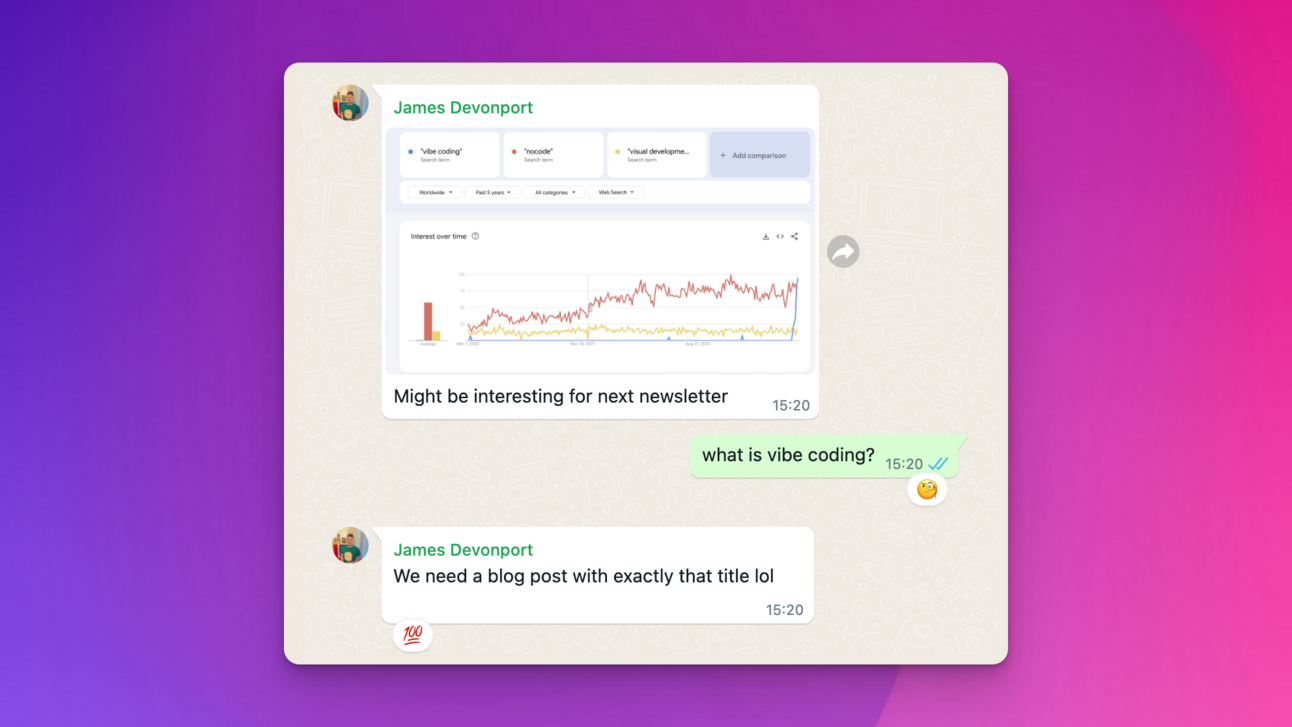
What is it, and why does it matter for no-coders?
If you’re on Twitter, you’ve probably noticed the buzz around “Vibe Coding,” a new approach described by Andrej Karpathy as “giving into the vibes”—embracing AI to handle 95% of your code. It’s all about being a “product engineer” rather than just a coder.
This approach exploded recently because:
- AI tools are getting good at writing reliable code.
- It promises productivity boosts
- It massively lowers the barrier to integrating code into your projects.
However, in my last newsletter I suggested that coding entire apps with AI is both too inconsistent and too hard to maintain for no-coders.
A lot of people replied in agreement saying their experience had mirrored mine.
But even since I sent that email, new AI models have been released (Claude 3.7 Sonnet in particular) which have meant significantly less errors are occurring.
However, I think my point still stands. At least for now.
In fact a Twitter user called @leojr94_ discovered it the hard way recently.
He built a SaaS with Cursor, shared it on Twitter, and people quickly found and exploited security holes.
He had to shut it down and is now rebuilding the whole thing in Bubble.
All this is to say… AI generated code isn’t yet anywhere near a point where non-coders can confidently build complex apps with it.
Which is why I’m proposing a new building method: hybrid building.
Hybrid building is combining no-code platforms and AI-generated code to get the best of both worlds.
In other words:
- You build most of your app using your favourite no-code tool
- You add small, finite but potentially game-changing functionality with AI-generated code
Why I like this approach
- You can do things that would be hard, if not impossible, with no-code. For example, crunching large amounts of data, writing complex algorithms, hosting static websites.
- You’re learning to code with AI… but in a digestible way. When you have 50 lines of code in front of you there’s a good chance you’ll be able to understand it all. When you have 50 files full of code there’s no chance.
- It’s the best of both worlds. Build fast with no-code and handle the core parts of your app such as user authentication, payments and dashboards on a platform you fully understand. Use AI-generated code where it makes sense to.
Hybrid building lets you break through no-code limitations without becoming a full-blown developer. Here’s why it’s powerful:
- Minimal code: Tiny amounts, targeted specifically where needed
- Huge productivity boost (think 10-100x, not kidding!)
- Better control and easier debugging
It’s not about becoming a programmer; it’s about using AI to amplify what you can do without losing your mind 😄
Real-life example (and why I’m hooked)
Last week, just for fun, I got AI to help me build a Cloudflare Worker that generates directory websites automatically from API calls.
(Cloudflare Workers are like little robots that sit in the cloud and run code for you quickly and efficiently - I’d hardly ever used them before last week but learned using AI).
A Bubble app (launched in minutes using my Bullet Launch boilerplate) takes a prompt, does research using Perplexity, stores the results in its database.
Then it does gets OpenAI to turn the list into nice structured JSON (JSON is just a structured format computers find easy to understand, a bit like a nested list) which gets sent to the Cloudflare Worker.
The Cloudflare Worker builds the site using static HTML and deploys it using Cloudflare pages.
The benefit of this approach is static Cloudflare pages are super fast to load and great for high SEO scores, something Bubble is not so good for.
I (or someday my users) still manage everything from their Bubble dashboard, but the API call triggers magic behind the scenes. The result? Instant directories, minimal hassle, maximum flexibility.
It’s exactly the sweet spot of hybrid building: no-code handles what it’s good at, and AI-powered code steps in when no-code hits a wall.
Action steps for Monday
- Identify one frustration you have with your no-code setup.
- Sketch a tiny, AI-powered coded solution to fix it.
- Spend an evening testing it out (Cloudflare Workers are a great starting point).
What do you think? Does Hybrid building have a future?
